Pages

Tuesday, January 27, 2015

The Uninvited by Geling Yan

Source: Google Images
I bought the book first before reading the review online. The back cover of the book have promised an ending full of anticipation and raised my curiosity which led to the purchase.

The pace I started the book was at my normal speed (not too slow, not too fast) and consistent till I got to the middle part where things slowed down. Do not have the time to read will be an excuse as it is more like I do not want to continue for I am at lost with the story and have lost the characters. 

Finally I reached the ending which turns out not to be as big of an ending as I have expected it to be from reading the back cover. The impression it gave me was there will be a big ending but as I finally reached the end, I felt as if it has not ended. As if it had ended abruptly and I am now left hanging.

Out with the bad, here comes the part that I enjoyed. 

What I like about the book is the way it has written about the culture in China. It is well described and has shows a different culture. It makes me think if it the same happens elsewhere? 

The book is an in between of good and bad for me. Not to say it is a must read but if you are interested to know about China, you can give it a go. 


I, for one, will not mind giving it a second chance to see if I'll have a different opinion and appreciate the story better. 

Monday, January 26, 2015

"I Have Done the Deed"

My first exposure to Javier Marias was a short story (read by Miette from Miette's Bedtime Story Podcast) called While the Women are Sleeping. I admired how he built his plot very slowly with seemingly ordinary scenes and conversations - and then a bang and you're left, together with the narrator, to think through what really just happened. (I wrote a short review here.)

A Heart So White - Javier MariasA Heart So White opened with the suicide of the wife of a newly wed couple, just off from their honeymoon. Gun to the heart, bam! off Teresa went to the other world.

The husband of the couple is Ranz, Juan's father.

Juan did not know much about his father's personal life, besides the fact that Teresa is his mother's elder sister. Juan did not ask for details; and when he did, Ranz refuse to divulge any information to him.

Juan marries Luisa, who, like him, is a translator and interpreter for various government bodies and organisations. He is extremely sensitive to words - or, more accurately, the act of interpreting words, of interpretation itself. For every scenes or events that unfold before him, he would, consciously or unconsciously, contemplate and interpret the meaning behind.

So how did the title of the book come about?

My hands are of your colour but I shame
To wear a heart so white.
-- Macbeth, William Shakespeare

Throughout the novel Marias interweaves the theme in a series of seemingly unrelated and trivial events. We see how the theme evolve in these events, and slowly begun to see - but only the tip of an iceberg - of what the author has in mind.

I personally think it is extremely intelligent of him to write this way. It was quiet for perhaps the first 3/4 of the book, and at the end we see the theme again, but written like a musical piece, a crescendo to a sforzando and then back to piano. (I really love the ending!) The events, the meanings behind these events, layer upon each other, weave by the common theme from that line of Macbeth; but there seems to be something beneath all these, a core theme. What is it?

That is, perhaps, what the author wants you to do - find your own interpretation.

One important thing to note about Marias is that he writes without a plot in mind; and he does not go back to whatever he has written, he just moves on from where he has stopped, which may explain this: Marias lets Juan think in long paragraphs, even during a conversation. The words loop around and around a single idea - do it few more times (just like how humans get obsessed with certain ideas/thoughts and repetitively think of it) and I feel like yelling at Juan/Marias to get straight to the point!

Oh, one thing that annoys me - why don't the female characters have any character? To me, they seemed to exist as purely a medium to get across what is on the author's mind. Even the minor male characters such as Custardoy the Younger gets more personality than Luisa. I wonder if it's the Spanish machismo.

Reading this book felt like reading Marias's thoughts. There are parts where it seemed that he/Juan is quite against the institution of marriage - no, scratch that - more like he is against the notion of getting into marriage without a purpose, doing just for the sake of it. Being a 20-something with friends who dream of/is getting married, I do find it quite comforting to know there are someone out there who shares the same thoughts as me - do we do things just for the sake of it, going with society's standard?

It is only 288 pages but you are definitely not going to finish in one sitting. Too heavy for that. Repetitions can get quite tiring, really, but I would say this is one brilliant book that I would go back again and again.

p/s The paperback published by Random House UK is wonderful, it doesn't crease at the spine nor does the cover "floats up"!! We need good binding like this :D

Read: Javier Marias interview on The Paris Review; Interview on The White ReviewGoodreads page

Sunday, January 25, 2015

Strawberry Shortcake

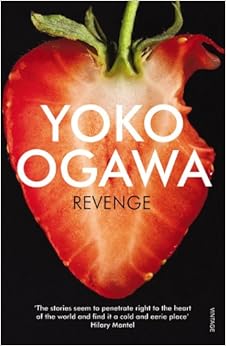
Every time I visit another country, I make a point to buy a book from the airport's bookstore. During my recent trip to Siem Reap, Cambodia, I've picked up two books and one of them is Yoko Ogawa's Revenge.

I have a love-hate relationship when it comes to collection of short stories. Sometimes it just doesn't make sense, or when you're just about to get to the core of the content, the story ended. But I really like it when I'm lucky or smart enough to notice the thematic structure that binds the stories together. And Revenge? Definitely one of the best collection of short stories I've ever read!

Revenge is composed of 11 disturbingly eerie stories that brilliantly pulls together a seemingly disconnected cast of characters. Strawberry shortcake, kiwi fruits, carrots, museum of torture, Bengal tigers... These short stories can be read individually yet they are interconnected, with the last one looping back to the first story.

What I really like about this book is..it is very inviting. Aside from the well crafted storyline, the curiosity on how will the next story links to the previous story will keep you reading. This book also explores the dark side of the most ordinary me and you. Everyday people, going through everyday struggles, dealing with complicated relationship. There are fear, jealousy, paranoia, feeling of longing.. It's all very real, relatable and maybe to a certain extend, it is what you secretly wants to do.

This post is so hard to write cause I don't want to talk about the story and spoil the fun of reading it. If you do plan to read this book, please read it in order.


Thursday, January 15, 2015

Make a wish?

Image from Amazon
I always want to read one of Alexandra Potter's books, only because they all have pretty covers (Can't help but judge a book by its cover). So here I am, after lying in my bookshelf for quite sometimes, I picked this as my first 2015 book.

It wasn't bad, but forgive me for being blunt, it is ordinary and cliche. There are many stories that are cliche and ordinary, but they dig deep into your emotions, and this book definitely could have done better in the emotional bits.

However, the message of the book is loud and clear, as the title said "Be Careful What You Wish For". Main character of this book is a British named Heather, she is 30 and single and going nowhere in her career, so she started wishing for tiny little things, and one day, after she met a gypsy, her wishes started to come true, big or small wishes. As she started getting what she wished, she begins to realize these things that seem so good, are not what she actually needs, because she doesn't feel happy.

There are times in our life when we wanted things, maybe better salary, or a position in an international company,  or to meet a guy that fits our perfect man checklist, just as Heather did. We want these things, because we don't have them, but we wouldn't know if these are the things that really suit us or are they what we really need, until it actually happens. It is often easier to know what we don't want, than to know what we actually want. Hence, be careful what you wish for.

I would say this book can be a good read during your free time, if you want a simple story that could make you smile, not too much twists and turns. But it isn't a book that you are going to remember for a long time, and definitely not something that worth reading a second time.

Sunday, January 11, 2015

Of a flying - maybe - chicken

I got attracted to this book because of the clean and cute, minimalistic design of the cover; as well as the presence of an animal - a flying chicken, really? - on its title. Based on the first page, I thought it would be quite a humorous read.

The Hen Who Dreamed She Could Fly (Goodreads page) started off with a hen named Sprout, trapped in a coup laying eggs for farmers, dreaming of freedom outside the coup, of hatching her own egg and taking care of her own chicks. With naive, half-baked plans and strong determination, she freed herself from the barn system - but realised the outside world wasn't as rosy as it seemed.

Out there, she met little friends but many foes; she witnessed life and death in front of her eyes; she gave out love as generously as she possibly could. All in all, she lived graciously and elegantly.

Do not dismiss this animal fable as another children's literature. It is as realistic and metaphorical as it gets. Despite the simple storyline, The Hen in essence is not as simple as the traditional fairy tales. It makes you ponder on life, family, morality and mother nature itself. Finishing the book left the same empty feeling I get whenever I finished a good book - so many lessons learned, so many unanswered questions left for me to contemplate.

Hwang describes well, and her language (after translation, at least) was not complicated. The many animal characters (minor & major) in the book - reminiscence of Animal Farm and Charlotte's Web - are as human as they can get. Nomoco's illustrations (including the cover) are raw and somehow reminded me of white, wintry North Korea. Don't know why.

My personal taste tells me the story ended somewhat cliche and emotional, it is, nevertheless, a good way to end. When/if I have children, I will read them this story. They need to know the world is not only about happy endings.

This book is so good I will not sell it away!

Author: Sun-mi Hwang
Translator: Chi-young Kim
Illustrator: Nomoco

Thursday, January 1, 2015

It Started With a Fall

Image source: Amazon
"I'm not most kids. I'm Louis Drax. Stuff happens to me that shouldn't happen, like going on a picnic where you drown."

I've always liked psychological/crime thriller so when I came across Liz Jensen's "The Ninth Life of Louis Drax" at a book fair, the title just sucked me in and I knew that I need to read this book.

People say don't judge a book by its cover and boy they are right. When I saw the title, I assumed that perhaps this book is about a boy who suffered from multiple personality disorder. Maybe he was traumatised... Turns out that I was in for another kind of ride (the 'ninth' here actually refers to his age).

Louis Drax is no ordinary boy. He is bright, precocious, and dangerously, disturbingly accident prone. At eight years old, he has experienced many accidents, some major, some smaller. But during a family outing to celebrate his ninth birthday, Louis falls off a cliff into a ravine and lapses into a deep coma. He was transferred to a clinic and Dr Dannachet tries to coax him back to consciousness. But the boy defies medical logic and the good doctor is drawn deeply into the heart of Louis' buried world. Only Louis holds the key to the mystery and he can't communicate...or can he?

Personally, I think Jensen did a brilliant job in terms of storytelling. She addressed every bit of details well and it was a very engaging read. Nothing was left hanging. The excitement (and disturbing-ness) of reading the early chapters were so strong that I couldn't put down the book once I've started it.

However, as I am a big fan of this genre, I was expecting a little bit more. Or maybe I was reading from a structuralist approach? I was preoccupied with identifying the patterns and that sort of laid out the ending for me.

It's a simple book to read (not so much for kids, maybe young adults) and at some point it reminded me of Mark Haddon's "The Curious Incident of the Dog in the Night-Time". There's a couple of common elements such as parenting, problem child, pets and first person narrative (again structuralist approach!) But that's about it. They're quite different and this one moves at a faster pace.


Not revolutionary but definitely worth a read.