Haruki Murakami's novella, The Strange Library (Taiwan version) is a pretty little hardcover, only 70 pages thick with Sheep Man and tiny gold specks on the front cover. So pretty, I cannot resist but grab a copy from the bookstore!
The short story was first published in the short story collection On Seeing The 100% Perfect Girl On One Beautiful April Morning back in the early 90s.
The Taiwanese Chinese version that I have is translated by 賴明珠 and includes illustrations by Kat Menschik from the German version. The illustrations are mainly grayscale with muted colours, very dark but elegant as well.
The story goes, as usual, very Murakami-esque:
A boy went to his local library intend to read up about tax collection during Ottoman empire. Unlike his usual trips, he was directed to a dark, creepy room underground by the librarian. There a strange, bald man led him through a maze of sorts, and then a small man covered with sheep skin locked him in a cell.
In the cell the boy is required to finish the 3 books the bald man has gave him, and which the bald man said will release after a month if he has finished the books. The truth was, however, that he might not end up alive.
That aside, the boy was fed extremely well by Sheep Man (great doughnuts) and met with a beautiful girl whose existence did not seem to be certain. In a peculiar way he found himself to be able to absorb the knowledge from the books much easier, and even able to experience the story itself. He also worried about his mother and his pet.
I always love the fantasy elements in Murakami's works, as if those alternate worlds do exist right here on Earth; and somebody we don't know is travelling through it. I am slightly disappointed that this is not quite a children's book (not an appropriate expectation); nevertheless I still adore the story and the accompanying illustrations a lot. My future trips to libraries will never be the same anymore.
p/s I wish I had browsed the English translations to get Ted Goossen's version instead :O
Saturday, February 21, 2015
Saturday, February 14, 2015
Dance to a __ song
My first encounter with Milan Kundera, a Czech-born writer and one of the world's best known author, through his best-known book, The Unbearable Lightness of Being. I remembered not being able to understand the story, being less like a novel but more of his meditation about Life and Humanity. It was really easy to read but to digest is another thing.
Slowness (Le Lenteur) is written 11 years after the publication of Unbearable. Like the latter, Slowness is a light piece of reading (known as one of his lightest work) but it certainly is not as shallow as that.
The author weaves stories that happened in a midsummer's night of more than 200 years apart together. For a slim volume (140 pages in the Chinese translation, which I finished in less than 2 hours)
Throughout the novel, Kundera talks about how each and every one of us are performers (here he uses the word "dancers"), performing in front of everybody or think we are performing in front of everybody. Using different circumstances in the book, he explains the concept of "performance" either in politics, social etc., which relates to self-identity ("id", in Freud's term?):
Also, just in time for Valentine's day:
Slowness (Le Lenteur) is written 11 years after the publication of Unbearable. Like the latter, Slowness is a light piece of reading (known as one of his lightest work) but it certainly is not as shallow as that.
The author weaves stories that happened in a midsummer's night of more than 200 years apart together. For a slim volume (140 pages in the Chinese translation, which I finished in less than 2 hours)
Throughout the novel, Kundera talks about how each and every one of us are performers (here he uses the word "dancers"), performing in front of everybody or think we are performing in front of everybody. Using different circumstances in the book, he explains the concept of "performance" either in politics, social etc., which relates to self-identity ("id", in Freud's term?):
When a person sees himself as elect, what can he do to prove his election, to make himself and others believe that he does not belong to the common herd? That is where the era founded on the invention of photography comes to the rescue, with its stars, its dancers, its celebrities, whose images, projected onto an enormous screen, are visible from afar by all, are admired by all, and are all beyond reach.Kundera also uses the concept of speed to describe memory, sensuality, and modernity. There are particular quotes in the book that I quite like:
There is a secret bond between slowness and memory, between speed and forgetting. Consider this utterly commonplace situation: a man is walking down the street. At a certain moment, he tries to recall something, but the recollection escapes him.And this:
Automatically, he slows down. Meanwhile, a person who wants to forget a disagreeable incident he has just lived through starts unconsciously to speed up his space, as if he were trying to distance himself from a thing still too close to him in time.
In existential mathematics, that experience takes the form of two basic equations: the degree of slowness is directly proportional to the intensity of memory; the degree of speed is directly proportional to the intensity of forgetting.
Why has the pleasure for slowness disappeared? Ah, where have they gone, the amblers of yesteryear? Where have they gone, those loafing heroes of folk song, those vagabonds who roam from one mill to another and bed down under the stars? Have they vanished along with footpaths, with grasslands and clearings, with nature? There is a Czech proverb that describes their easy indolence by a metaphor: "they are gazing at God's windows." A person gazing at God's windows is not bored; he is happy. In our world, indolence has turned into having nothing to do, which is a completely different thing: a person with nothing to do is frustrated, bored, is constantly searching for the activity he lacks.At the end the stories fold itself back to the narrator. I found it rather peculiar, but cliche as well, as if I had seen it coming. I personally felt this cliche spoiled the story, but it may just be my personal taste. Honestly I read this book just to clear off my book shelves haha so it did not leave a deep impression to me. (It is also a disrespect to the author!) Alas, this book is not meant to be rushed to be enjoyed in slowness ;)
Also, just in time for Valentine's day:
The religion of orgasm: utilitarianism projected into sex life; efficiency versus indolence; coition reduced to an obstacle to be got past as quickly as possible in order to reach an ecstatic explosion, the only true goal of love-making and of the universe.;)
Saturday, February 7, 2015
It Started With A Murder
If there's someone who can make me forget about playing Tetris and stay up really late to read, that person has got to be Keigo Higashino. Damn, I wish he wrote my text books.
Higashino is a Japanese author famed for his mystery novels. His writing style is clean, simple and he doesn't involves too many characters. I have no idea how he does this but I've read at least 20 of his works and yet he surprises me every single time. There may be a some overlapping themes (femme fatale, dishonesty, revenge) but his approach differs from each book. From a scientific narrative to a melo-drama David Lynch-esque complexity.. you name it.
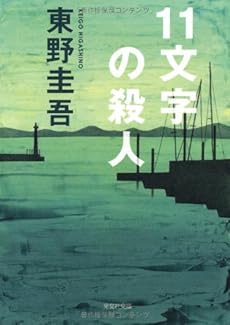
Anyway, for my third book, I've picked "The Case of 11 Letters" and did I mentioned that Higashino never fails to impress?
As she digs deeper, she discovers that all the victims were once passengers on the same cruise ship a year ago and involved in an accident that left one man dead. What happened on the cruise ship? Was the man murdered or was it an accident? Is someone seeking for revenge?
If I have to pick something about this story, I feel that the last murder was a little out of place/ coherence feels off. Turns out that this murder has got to do with the big reveal. I kind of saw this coming but Higashino being Higashino, adds a little twist. This little twist is not so much about 'who did it' or 'how did it happened' but it is something that every mystery novel should have.
Thursday, February 5, 2015
Kokuhaku こくはく Confessions
Kokuhaku means "confessions" in English. The Japanese has a kokuhaku culture in which the men/women confess their love/feelings to each other. If the confession cum proposal is accepted, they will officially start dating each other/be in a serious relationship!
It has been a week since I finished reading Confessions by Kanae Minato (Mandarin translation version, 告白); and until today whenever I thought of the book, I still feel really disturbed.
Confessions started off with a goodbye speech given by a teacher of a middle school, Yuko Moriguchi, who was retiring after her daughter was found dead in the pool not long ago. She later revealed that her daughter's death was not accidental, but a murder conducted by two students in her class, making them recognisable to the rest of the students without giving out their names. Before she left, she unveiled her revenge plan - taint the milk of the 2 students, Shuuya Watanabe and Naoki Shimomura, with HIV-tainted blood.
The rest of the story proceeded with different points of view given by different characters, peeling the layers one by one of a seemingly simple crime story. I thoroughly enjoyed how the story gets deeper as it goes, stories behind stories; and when there is nothing left to be uncovered, be prepared to be surprised with the conclusion.
Moriguchi-sensei decided against reporting the case to the police as the Japanese law do not punish juveniles harshly, and felt it was best to take it to her own hands. She succeeded, and very well indeed. No-one was left unaffected. Strings of bully cases, social disruption, more murders - did Moriguchi-sensei want to take revenge against the two students only, or bring everyone else down with them?
And what about justice? How much justice is enough?
The narration of the story flows really well even with different perspectives of the story told. Each page is packed with shocks and twists, making it impossible to leave the book until you reach the last page.
Minato was a housewife before she became famous with this book. I really wonder what goes on in the minds of the average Japanese.
p/s I love this review of the book!
It has been a week since I finished reading Confessions by Kanae Minato (Mandarin translation version, 告白); and until today whenever I thought of the book, I still feel really disturbed.
Confessions started off with a goodbye speech given by a teacher of a middle school, Yuko Moriguchi, who was retiring after her daughter was found dead in the pool not long ago. She later revealed that her daughter's death was not accidental, but a murder conducted by two students in her class, making them recognisable to the rest of the students without giving out their names. Before she left, she unveiled her revenge plan - taint the milk of the 2 students, Shuuya Watanabe and Naoki Shimomura, with HIV-tainted blood.
The rest of the story proceeded with different points of view given by different characters, peeling the layers one by one of a seemingly simple crime story. I thoroughly enjoyed how the story gets deeper as it goes, stories behind stories; and when there is nothing left to be uncovered, be prepared to be surprised with the conclusion.
Moriguchi-sensei decided against reporting the case to the police as the Japanese law do not punish juveniles harshly, and felt it was best to take it to her own hands. She succeeded, and very well indeed. No-one was left unaffected. Strings of bully cases, social disruption, more murders - did Moriguchi-sensei want to take revenge against the two students only, or bring everyone else down with them?
And what about justice? How much justice is enough?
The narration of the story flows really well even with different perspectives of the story told. Each page is packed with shocks and twists, making it impossible to leave the book until you reach the last page.
Minato was a housewife before she became famous with this book. I really wonder what goes on in the minds of the average Japanese.
p/s I love this review of the book!
Labels:
Gothic,
Japanese,
Psychological thriller,
translation,
Zee
Subscribe to:
Comments (Atom)